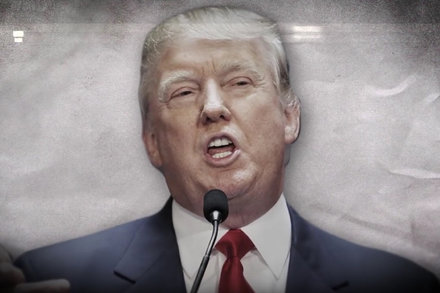
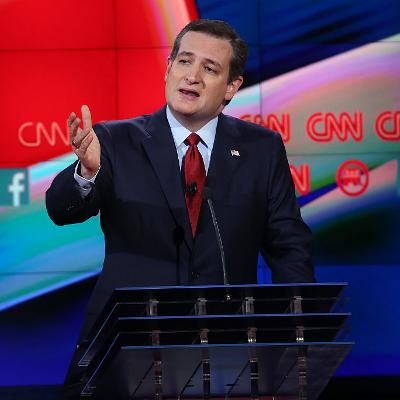
Carly Fiorina said she’s been “called every b-word in the book” at the Republican debate

vox

Updated by  via VOX

Photo Source: The Daily Beast

Carly Fiorina said in her opening statement at the CNN Republican debate on Tuesday that she has been “called every b-word in the book.”

Fiorina clearly meant “bitch,” or perhaps “bossy” — in any case, a gendered insult. The comment, and indeed her entire opening statement, was heavily focused on the ways she has struggled to overcome specifically gender-based obstacles to get to the top.

In discussing her struggles and challenges, Fiorina led off with very gendered ones: “I have been tested. I have beaten breast cancer. I have buried a child.”

Then she transitioned into her corporate and political ladder climbing: “I started as a secretary. I fought my way to the top of corporate America while being called every b-word in the book. I fought my way into this election.”

And later on in the debate, Fiorina paraphrased Margaret Thatcher: “If you want something talked about, ask a man. If you want something done, ask a woman.”

It’s likely that Fiorina is trying to set herself up as an opponent who could neutralize one of Hillary Clinton‘s big talking points — her potential status as first woman president of the United States. That could diffuse Clinton’s support from people who generally want to see a woman president; one report found donors who gave to both Clinton and Fiorina, despite their stark differences on policy.

Fiorina may scorn liberal identity politics, but she has had no problem with the word “feminism,” or with discussing the ways that being a woman presents unique challenges to her that men don’t have to deal with. She calls out sexism when she sees it used against her, like her ad pushing back against Donald Trump for making fun of her face. “A feminist is a woman who lives the life she chooses,” Fiorina has said. “A woman may choose to have five children and home-school them. She may choose to become a CEO, or run for President.”

But Fiorina’s feminism is a very individualistic, have-it-all, lean-in, corporate type of feminism — one where any woman can make it to the top if she just “fights” hard enough. One where talking about comprehensive access to reproductive health care is actually an insult to women because it supposedly reduces them to their body parts and makes them dependent on government. And one that doesn’t acknowledge the structural challenges, from implicit bias in the workplace to the impossible “choice” between family income and child care, that make living “the life she chooses” easier said than done for too many American women.

Group Backing John Kasich Likens Donald Trump to Hippo in New Ad

HIPPO-CRIT

By NICK CORASANITI via NYTimes

New Day for America, a “super PAC” supporting Gov. John R. Kasich of Ohio, is aggressively attacking Donald J. Trump, now with a mocking commercial titled “Hippo-Crit” that suggests Mr. Trump belongs in the White House about as much as he belongs in a zoo.

On Screen

Mr. Trump and a hippopotamus, their mouths agape, alternate or share the screen, as a visual device resembles the bars of a cage. Both are seemingly “voiced” by the snorts and grunts of an indeterminate off-screen mammal. Unflattering images of Mr. Trump flip or spin away before surveillance-style images show Trump-brand neckties made in China and his “palatial D.C. hotel” being built by “illegal immigrants.” Available to save the day in the end is Mr. Kasich, shown in a contemplative pose beside an American flag and a large, Oval Office-like window.

The Message

Other attacks on aspects of Mr. Trump’s background have whiffed. But this ad pungently goes after Mr. Trump on two of the red-meat issues that have made him so popular with rank-and-file Republicans: illegal immigration and the outsourcing of American jobs.

Fact Check

Mr. Trump’s name-brand ties are indeed made in China, a decision he defended on grounds that China “has manipulated their currency to such a point that it’s impossible for our companies to compete.” The Washington Post found several workers at Mr. Trump’s Washington hotel project who had entered the country illegally. His campaign says the project is following all applicable laws.

Where

On New Hampshire television stations as part of a $2.5 million ad campaign against Mr. Trump.

Takeaway

Attacking Mr. Trump on immigration and jobs — issues on which he has based much of his campaign — and with the sort of ridicule that Mr. Trump has used on others, could gain Mr. Kasich some much-needed attention.

via IFTTT

Chris Christie Reminds Voters, Again and Again, of His Prosecutor Days

christie

By ALAN RAPPEPORT via NYTimes

Most governors who seek the presidency promote executive experience as their chief credential, regaling voters with tales of big decisions they have made and budgets they have balanced.

Gov. Chris Christie of New Jersey also mentions those things, but lately he has been digging deeper into his résumé. With terrorism taking center stage in the 2016 race, Mr. Christie seems to take the most pride in his days as a federal prosecutor.

Five times during Tuesday’s Republican presidential debate, and often unprompted, Mr. Christie managed to work in the fact that he was once a United States attorney in New Jersey. The experience, he argues, makes him best suited to destroy the Islamic State.

“I will tell you this, I’m a former federal prosecutor, I’ve fought terrorists,” Mr. Christie said in opening remarks.

Moments later, when asked how he would alleviate the fear of terrorist attacks that has become pervasive in America, Mr. Christie said that because of his work as a prosecutor he knew that terrorists were planning attacks elsewhere. People have good reason to be worried, he suggested.

“I could tell you this, as a former federal prosecutor, if a center for the developmentally disabled in San Bernardino, Calif., is now a target for terrorists, that means everywhere in America is a target for these terrorists,” Mr. Christie said.

As rivals debated the details of immigration policy, Mr. Christie jumped in to make the case that Senator Marco Rubio and Senator Ted Cruz were just talkers who knew nothing about really fighting terror. As a prosecutor, he reminded viewers again, he has actually gone up against terrorists.

“This is the difference between having been a federal prosecutor instead of being one of 100 people debating it,” Mr. Christie said, explaining that he had used the Patriot Act to stymie attacks in New Jersey.

Mr. Christie was appointed as federal prosecutor in 2001 and served in that role until 2008, before becoming New Jersey’s governor. His popularity in the state has faded in recent years amid economic turmoil, the George Washington Bridge scandal and frequent travel around the country to raise money and campaign for higher office.

Looking to jump-start his flagging presidential campaign, Mr. Christie has latched onto his experience from the aftermath of attacks of Sept. 11, 2001, to remake himself as a national security candidate.

As Tuesday’s debate was winding down, the conversation turned to taking in Syrian refugees. Mr. Christie has taken a hard line on the issue, saying that none should be accepted and pointing to concerns raised by James Comey, the F.B.I. director.

“Now, listen, I’m a former federal prosecutor, I know Jim Comey,” Mr. Christie said, mentioning that the two go way back and had even worked together in law enforcement. “He was the U.S. attorney in Manhattan when I was a U.S. attorney in New Jersey.

via IFTTT

Politics: Republicans Reveal Discord in Debate Over Dictators

A sharp move away from the adventurous foreign policy of George W. Bush

by Mark Thompson

Republican presidential candidates revealed just how far the Republican Party has moved in the decade since President George W. Bush called for spreading democratic principles through the Middle East, sometimes by force. Much of Tuesday’s debate focused on the role the U.S. has played in toppling them in Afghanistan, Egypt, Iraq and Libya—and trying to force out Bashar Assad in Syria—since the terror attacks of 9/11. The certainty that most dictators are bad, not just for their people but for American interests, was no longer a given for Republican candidates, as the U.S. struggles with militants exploiting the vacuums left behind by toppled authoritarian states.

“If you believe in regime change, you’re mistaken,” Kentucky Senator Rand Paul said during the Las Vegas debate.

“We keep hearing from President Obama and Hillary Clinton and Washington Republicans that they’re searching for these mythical moderate rebels,” Senator Ted Cruz of Texas complained. “It’s like a purple unicorn—they never exist. These moderate rebels end up being jihadists.”

Cruz said that the White House “and, unfortunately, more than a few Republicans” have made ridding the world of megalomaniacs like Muammar Gaddafi, who ruled Libya for 42 years until he was ousted and killed in 2011, more important than keeping Americans safe. “We were told then that there were these moderate rebels that would take over,” Cruz said. “Well, the result is, Libya is now a terrorist war zone run by jihadists.” Much the same thing happened in Egypt, he claimed, when “the Obama Administration, encouraged by Republicans,” ousted longtime U.S. ally Hosni Mubarak, and is happening again in Syria.

“We need to learn from history,” Cruz said. “Assad is a bad man. Gaddafi was a bad man. Mubarak had a terrible human rights record. But they were assisting us—at least Gadhafi and Mubarak—in fighting radical Islamic terrorists.” If Assad is removed, “the result will be ISIS will take over Syria, and it will worsen U.S. national security interests.”

Marco Rubio, the Florida senator who pushed for Gaddafi’s ouster, saidrealpolitik sometimes requires distasteful partners. “We will have to work around the world with less than ideal governments,” he said, citing Jordan and Saudi Arabia, which caused heartburn in Amman and Riyadh.

Neurosurgeon Ben Carson said “the Middle East has been in turmoil for thousands of years,” and the idea that U.S. military involvement will straighten things out is misguided: “No one is ever better off with dictators but…we need to start thinking about the needs of the American people before we go and solve everybody else’s problems.”

Jeb Bush said toppling Saddam Hussein—a 2003 war initiated by his brother, President George W. Bush—was a good thing. But he added that its key lesson is that the U.S. must have “a strategy to get out” and leave a “stable situation” behind. That has never been a U.S. strength. Invasions are quick, easy and relatively cheap compared to the decades-long push to try to rebuild a more moderate nation to replace a dictatorship. Americans may dislike war, but they dislike pumping billions to rebuild shattered counties even more.

Paul agreed that it’s the what-comes-next question that has dogged U.S. policy since 9/11. “Out of regime change you get chaos,” he said. “From the chaos you have seen repeatedly the rise of radical Islam.” The issue is one of “the fundamental questions of our time,” and not necessarily black and white. “I don’t think because I think the [Iraq] regime change was a bad idea,” Paul said, “it means that Hussein was necessarily a good idea.”

For generations, the U.S. fought left-wing dictators (Fidel Castro in Cuba, for example) while bolstering right-wing autocrats (Augusto Pinochet in Chile). This was largely because of the Cold War, where leftist regimes allied themselves with the Soviet Union, and rightist ones cozied up to the U.S. But it has been 25 years since the Soviet Union’s demise. That’s unleashed all sorts of local tensions, ranging from nationalist to religious, that the Cold War had kept largely tamped down.

Nowhere has that energy exploded as quickly and violently as in the so-called arc of crisis stretching from northern Africa, through the Middle East, and on to the Central Asian states. Fueled by the nearly 1,500-year split between the Shia and Sunni branches of Islam, the collapsing regimes have entangled the U.S. in civil and religious wars and triggered the rise of terror groups like al Qaeda and ISIS.

“We’ve spent $4 trillion trying to topple various people,” Donald Trump said, referring to the eventual total price tag of the Afghan and Iraq wars. “It’s not like we had victory—it’s a mess.” While the debate over the pros and cons of backing—or, at least, not attacking—dictators will continue, no one on stage challenged Trump’s accounting.


Read more: http://ift.tt/1QqDehf

Debate Shows G.O.P. Race’s Volatility as Ted Cruz Holds Steady

By MATT FLEGENHEIMER & JONATHAN MARTIN – NYTimes

[Ashley Parker contributed reporting from New York.]

Senator Ted Cruz emerged from Tuesday night’s Republican debate later largely unscathed, weathering attacks from Senator Marco Rubio, avoiding them from Donald J. Trump and giving little reason to doubt that his rise among Tea Party and evangelical voters will continue.

The Texas senator’s steady performance in the debate seemed likely to solidify his ascendant standing in Iowa, where he has surpassed Mr. Trump in some recent polls.

While the candidates pressed their cases in interviews on Wednesday and prepared to set off on the last stretch of campaigning before a likely holiday lull, the debate seemed to confirm the volatility of the race in New Hampshire and beyond, adding little clarity as to which man or woman might emerge as the favorite among center-right Republicans.

Mr. Trump, who leads in national polls, slogged through an uneven night, though forgettable debate performances have in the past had little effect on his support. Perhaps most notably, Mr. Trump resisted repeating past criticisms of Mr. Cruz during the debate and in interviews afterward. For days before the debate, Mr. Trump had assailed Mr. Cruz, who questioned the billionaire’s judgment at a private fund-raiser last week but who has remained publicly deferential. Yet Mr. Trump cast aside any strategic imperative to halt Mr. Cruz’s momentum in Iowa, continuing his habit of holding fire on somebody unwilling to attack him first onstage.
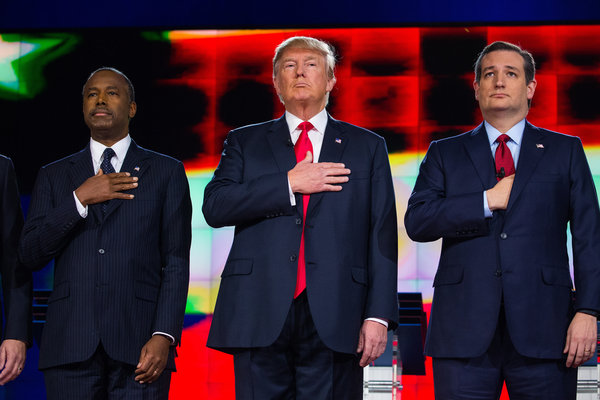
17repubsweb1-articlelarge
Donald J. Trump, center, repeating past criticisms of Ted Cruz, right, during the debate and in interviews afterward. (Credit: Ruth Fremson / The New York Times)

“I just think he didn’t say anything that I particularly disagreed with,” Mr. Trump told CNN after the debate.

After facing two forces to which he is unaccustomed — an often unsympathetic crowd and an effectively pugnacious Jeb Bush — Mr. Trump planned on Wednesday to return to his campaign comfort zone with a midday rally in Mesa, Ariz.

Mr. Bush, meanwhile, appeared energized, beating rivals to the cable airwaves from Las Vegas in a slew of interviews around 4 a.m. Pacific time.

After appearing to irritate Mr. Trump in a series of exchanges during the debate, a triumph that bordered on catharsis for many supporters of his long-languishing campaign, Mr. Bush and his team moved quickly to convince donors that he was seizing the momentum from his pointed attacks on the developer.

“I don’t think he’s a serious candidate — I don’t know why others don’t feel compelled to point that out, but I did,” Mr. Bush said Wednesday on CNN, adding, “Donald Trump is not going to be president of the United States by insulting every group on the planet, insulting women, P.O.W.s, war heroes, Hispanics, disabled, African-Americans.”

Mr. Bush’s performance on Tuesday was particularly sweet for a campaign whose candidate had flubbed a memorable confrontation with Mr. Rubio in a previous debate.

“We know debates do matter,” Sally Bradshaw, one of Mr. Bush’s top advisers, told donors on a conference call immediately after the debate. “We have seen the downside of that. I think we can celebrate tonight that we’ll see the upside of that.”

Mr. Bush, who was scheduled to hold a private gathering with supporters in Nevada on Wednesday, now finds himself tussling on two fronts in New Hampshire, a state increasingly viewed as decisive for his fortunes: In addition to Mr. Trump, Mr. Bush must contend with establishment favorites like Mr. Rubio and Gov. Chris Christie, who had another strong showing on Tuesday and who has been rising in polls in the state, which holds the nation’s first primary, on Feb. 9.

There is also Gov. John Kasich, whose “super PACwas to begin running ads in New Hampshire on Wednesday criticizing Mr. Christie’s fiscal record. It is at once an acknowledgment of Mr. Christie’s renewed strength there and a signal of that state primary’s present chaos.

“For the jumbled-up establishment lane, it’s now even more congested,” said Matt Strawn, a former Iowa Republican chairman. “And Cruz’s lane is totally clear.”

Mr. Rubio, coming off another broadly well-received debate performance, plans to appear on Wednesday at rallies in both Iowa and New Hampshire. For the second consecutive debate, the focus afterward centered in large measure on Mr. Rubio and the party’s approach to immigration policy.

Mr. Cruz, who has since the last debate repeatedly highlighted Mr. Rubio’s past support for bipartisan immigration reform that included a pathway to citizenship, sought in television interviews to tie the Florida senator’s position to recent terror threats.

17repubsweb3-articlelarge

Jeb Bush with his wife, Columba, after the debate. (Credit: Ruth Fremson / The New York Times)

“This is one of the first times we really discussed how the Rubio-Schumer amnesty plan would have endangered our national security,” Mr. Cruz said on Fox News, referring to Senator Chuck Schumer, the New York Democrat. (Mr. Rubio, appearing Wednesday on Fox News, also invoked the liberal senator while criticizing Mr. Cruz’s support for limits on surveillance programs, saying Mr. Cruz had “aligned himself with Barack Obama and Chuck Schumer and the A.C.L.U. and every other liberal group in America.”)

Mr. Cruz told CNN that the confrontations with Mr. Rubio were unsurprising because “Senator Rubio’s campaign has been running attack ads against me, and I think they’re concerned” at the prospect of conservatives’ uniting around Mr. Cruz.

But Mr. Rubio’s campaign has reveled since the debate in what it saw as a mealy-mouthed response from Mr. Cruz to a question about whether he could support legal status for people in the country illegally.

“I have never supported legalization,” Mr. Cruz said, countering a claim from Mr. Rubio, “and I do not intend to support legalization.”

Mr. Rubio’s communications director, Alex Conant, said on Twitter, “After this debate, I don’t intend to celebrate too much.”

Michael Meyers, a veteran Republican strategist, said that Mr. Rubio “proved he could handle some punches” on a night when Mr. Cruz and Senator Rand Paul often teamed up to knock him. But Mr. Rubio, Mr. Meyers added, “didn’t prove he could really sting Cruz.”

The Cruz-Rubio dynamic appears to be growing more confrontational beyond the debate stage, as well. Republicans in Iowa this week received their first piece of mail from Mr. Rubio’s super PAC criticizing Mr. Cruz for his vote to limit the National Security Agency’s metadata program. (Mr. Cruz has said an alternative program had, in fact, strengthened the country’s ability to fight terrorism.)

“These men undermined our intelligence agencies’ ability to stop terrorist attacks,” the mailer reads, below a photo of Mr. Cruz, Mr. Paul, President Obama and Senator Harry Reid.

Yet in a sign of how reluctant the candidates and their allies are to imperil their own prospects by going aggressively negative, the literature points to the efforts of Senator Tom Cotton of Arkansas, not Mr. Rubio, to protect robust surveillance laws.

For others, the debate — the last major scheduled event for Republican candidates this year — prompted fresh questions about the viability of their campaigns.

Carly Fiorina, appearing Wednesday on CNN, chafed at a remark about her struggles in the polls. “Oh wow, you’re like declaring an end to my candidacy,” she said. “I think we’re just getting started.”

Minutes later, Senator Lindsey Graham, who was considered a standout by many in the so-called undercard debate of lower-polling candidates, made a pitch to viewers after a questioner noted that he was funny.

“I am hilarious — send money, if you want to keep me in this race,” he said, adding, “I’m not speaking again until somebody sends $100,000.”