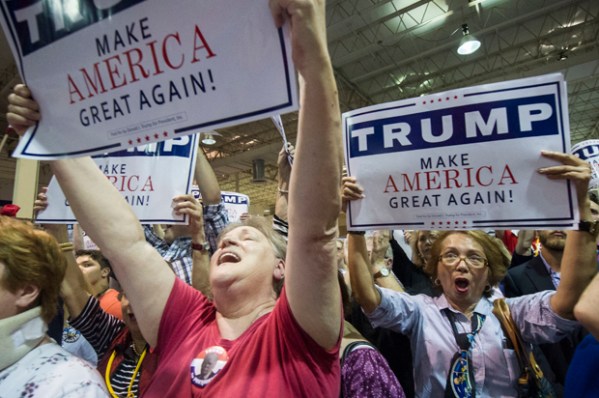
R.I.P., GOP: Party of old, disillusioned white people is dying a slow death

Changing Demographics will be the death knell for the Republican Party — even though it may take White House in ’16

www872

Credit: Samuel-Warde

No matter who wins the nomination battle, the Republican Party has a much bigger problem: demographics. A new report released by the Center for American Progress analyzed the demographic advantages for Democrats in 2016 and beyond and the results are overwhelmingly positive.

And this should surprise no one.

Observers on both sides have long questioned the Republican Party’s viability in an increasingly progressive and less white America. With every national election, it becomes more obvious that the GOP’s “Southern Strategy,” which exploited racial and cultural resentment for votes, has finally backfired.

As The Nation’s William Greider wrote in October: “The GOP finds itself trapped in a marriage that has not only gone bad but is coming apart in full public view. After five decades of shrewd strategy, the Republican coalition Richard Nixon put together in 1968 – welcoming the segregationist white South into the Party of Lincoln – is no devouring itself in ugly, spiteful recriminations.”

Greider was responding to the resignation of House Speaker John Boehner, who left on account of the nihilistic Tea Party caucus. The Tea Party extremists in Congress, like the social conservatives who supported them, are part of a reactionary movement of cultural discontents whose only purpose is to negate and obstruct, and they’ve proven that in office.

This movement, which has consumed the Republican Party, consists primarily of old and disillusioned white people who are rejecting a world that, in many respects, has passed them by. The nativism, the xenophobia, the social hysteria, the religious demagoguery – this is what defines the GOP now, and it stems from the party’s cynical plot to capitalize on cultural angst nearly fifty years ago.

Although it worked in the short and medium-term, the “Southern Strategy” is now the most likely cause of death for the Republican Party. Republicans still hold 31 of 50 state governorships and they control most state legislatures, but that’s not the problem. Today and moving forward, the GOP will find it harder and harder to compete for national elections.

By appealing to the fears of culturally isolated white people, the Republican Party has created an intractable demand-side problem: Gradually, their platform has become dominated by social and religious issues which alienate nearly everyone outside of their base. Given the shifting demographics in this country, this portends doom for the GOP.

From the Center for American Progress report:

“Recent social trends present significant headwinds for Republicans, particularly as they relate to demographic shifts in the country. For years, Republicans could rely on white voters—and, in particular, working-class whites—to constitute a decisive proportion of the electorate and deliver victory. This is no longer the case. As documented in the 2014 “States of Change” report—published jointly by the Center for American Progress, the American Enterprise Institute, and the Brookings Institution—the percentage of white voters in the actual electorate dropped 15 percentage points, from 89 percent in 1976 to 74 percent in 2012. The percentage of white working-class voters dropped even more, decreasing by 26 points over the same period. Future projections in the “States of Change” report suggest that the percentage of eligible white voters in the American electorate will drop to 46 percent by 2060…The decline in the white percentage of the electorate has coincided with stronger Democratic identification and voting patterns among nonwhite voters, as well as increasingly more liberal social views among higher-educated white professionals.”

The writing is on the wall, in other words. In its current form, the GOP can’t survive, not if these projections are even remotely accurate. It will become a regional party, propped up by parochialism and gerrymandered districts. None of this means the Republicans can’t win in 2016. What it does mean, however, is that they’ll have to overcome a significant demographics disadvantage, a disadvantage that will only grow over time.

For the Democrats, the landscape is far more encouraging. Virtually all of the numbers favor a Democratic candidate in 2016:

“If the Democrats receive their 2012 levels of support among these three groups in 2016—an 11-point deficit among white college graduates; a 22-point deficit among white working-class voters; and a 64-point advantage among minority voters—the party will easily win the popular vote by a 6-point margin. If support for the Democrats among minorities declines to our more conservative estimate of 78 percent, they would still win the popular vote by 4 points. If, on top of that diminished minority support, white working-class support replicates the stunning 30-point deficit congressional Democrats suffered in 2014, while support among white college-graduates remains steady, the Democratic candidate would still win the popular vote—albeit by a slender margin. If, however, white college-graduate support also replicates its relatively weak 2014 performance for the Democrats—a 16-point deficit—Republicans would win the popular vote by a single point.”

The popular vote won’t decide the election, but it’s an indication of where the country is politically. The Democrats have won the popular vote in five of the last six presidential campaigns – that trend will continue and, eventually, it will translate into more and more electoral votes.

In 2016, all the Democrats need to do is hold on to the Obama coalition, and even that’s not entirely necessary. As the CAP report notes, the “sobering reality for Republicans is that the Democratic candidate will be able to absorb mild levels of defections or lower levels of turnout from its core voters in the general election and still capture an Electoral College majority.” Because of its over-reliance on white male voters, however, the GOP can’t win a national election unless turnout is historically low for the Democrats. And they still have to appeal to a cross-section non-ideological working-class voters. But the anger and the bitterness pulsating through their base at the moment will surely turn moderates and independents off, and the GOP can’t afford that.

Whatever happens next year, it’s clear that the GOP is slowly pandering its way into oblivion. The country has changed demographically, culturally, and politically – and the Democrats have changed with it. The Republican Party has not. And if Donald Trump’s present success is any indication, it’s headed in the wrong direction.


Written by  via SALON

How Hillary Clinton could win the White House by March

First, crush Marco Rubio, and then take the rest of the year off.

mw-dx468_arends_20151023161719_zh
(Source: Getty Images/ Chip Somodevilla)

Hillary Clinton’s only real competition among Republicans is Marco Rubio. Ted Cruz and Donald Trump are too extreme for most Americans, and truly leave her unparalleled in experience and political clout.

If Hillary Clinton and her allies are smart, they’ll spend their $50 million-plus campaign war-chest over the next few months making sure Marco Rubio doesn’t get the Republican nomination.

They’ll run ads in the primary states trashing the Florida senator among conservatives — cleverly hiding the source of the ads behind secretive super PACs with conservative-sounding names.

They’ll encourage Democratic activists to cross over to GOP primaries to support Rubio’s extremist opponents.

Hillary herself may even help out by making a couple of high-profile speeches in which she praises Rubio for his “moderation” and “bipartisanship” — especially, she might say, “on the subject of immigration.” Nothing could hurt the young senator more with the GOP base.

Obama could take him golfing.

Following this week’s Republican debate, it looks increasingly like the race is down to three candidates: Texas Sen. Ted Cruz, real-estate huckster Donald Trump and Rubio.

If the GOP goes ahead and picks Cruz or Trump, Hillary could probably take the rest of 2016 off to work on her inauguration speech. Both men are extremists, and are traveling with more baggage than Kim Kardashian. The only people who think they are remotely electable in a general election are the increasingly narrow group of people who make up the Republican party base.

We’re talking about people who think “Benghazi” is one of the top three issues facing America.

Who think global warming is a sinister “one-world” plot to take away our pickup trucks and make us all slaves.

And who think 300 million guns are making us all “safe” while 5-year-old Syrian refugees are going to kill us.

The biggest single fact: While individuals rise and fall from poll to poll, overall the four extremist candidates of Trump, Cruz, Rand Paul and Ben Carson have been consistently sharing about 65% in GOP polls.

It’s hard to credit, but the party of Abraham Lincoln has apparently become the party of Jefferson Davis. “Angry white men of the South, arise!” (Yes, Carson, an evangelical Christian, is African-American — showing that even the most conservative coalitions can evolve.)

Meanwhile, the party is losing millennials, professionals, the college-educated, women and Hispanics by wide margins. Good luck with that.

Rubio, on the other hand, could pose a serious challenge to Hillary. He’s a young, telegenic Hispanic American. Her best chance to stop him is now, not next fall.

Yeah, I know, people will say I’m only writing this because I’m part of the fancy-pants, pointy-headed elitist East Coast liberal media and therefore cheering for Hillary.

That couldn’t be further from the truth.

As a member of the media, I stand to gain the most if America elects an extremist wacko who generates lots of news, most of it bad. Trump would be the best. Under President Trump, no journalist would want for a job, and no website for eyeballs — at least until he was impeached, America declared bankruptcy or nuclear war killed us all. Failing Trump, any of the other GOP extremists would be just fine. Among the Democrats, Bernie Sanders would be pretty good for the news business too.

For journalists, Hillary Clinton would be a terrible president. It would be four or eight years of guaranteed boredom — unless she divorced Bill, say, or had a fling with a male intern in the Oval Office.

Yet, facts are facts. At this point, it seems almost certain it’s going to be Clinton and Rubio. And if Hillary Clinton has smarts, she’ll make sure it isn’t Rubio.

Eight years ago, Rush Limbaugh and right-wing Republicans inserted themselves into the Democratic primary process by launching “Operation Chaos.” Perhaps some Democrats may feel it’s time to return the favor.

If pro-Clinton allies are smart, they’ll create new secretive super PACs with names like “Patriots for American Values” and “Veterans for American Families” and “Patriotic American Veterans for American Family Values.”

And then they’ll swamp the airwaves in Iowa, New Hampshire, South Carolina and elsewhere with ads trashing Marco Rubio among conservatives.

Say he’s soft on Hispanics, Muslims and other non-Aryans.

Say he’s for “amnesty.”

Say he’s a “career politician” who’s “never had a real job.”

And take a leaf out of the New York Times’ preposterous stories and say that he’s fiscally irresponsible because he had to pay late fees on his credit cards a couple of times. Oh, yeah, and he once leased a Lexus with his own money.

They’ll tie Rubio’s personal loans to the issue of the rocketing national debt. “If Marco Rubio can’t even handle his own finances, how can we trust him with America’s?” No, it makes no sense, but what’s that got to do with anything?

Stay tuned.

Published: Dec 18, 2015

Poll: 30 Percent of Republican Voters Favor Bombing any Arab-sounding country, even fictional nation from ‘Aladdin’

SMH.

Is this a joke? This has to be the same demographic of voters who also believe Donald Trump’s outlandish claims of having seen “thousands of Muslims cheering” in New Jersey on anniversary of 9/11.

DKathleen Hastings, Elizabeth Musngi

(Credit: AP / John Amis)

According to a new Public Policy Polling (PPP) poll, 30 percent of Republican primary voters nationally support bombing Agrabah, the made up home of Disney’s Aladdin, and 34 percent support Donald Trump for president.

Of course, Trump leads the crowded pack of GOP presidential wannabes overall with a whopping 34 percent support nationally. His nearest rival, Ted Cruz, stands at 18 percent. Of those Republicans who would like to bomb the fictional land of Aladdin, support for Trump is at 45 percent. To their credit, 57 percent of Republicans at least responded that they weren’t sure if the U.S. should bomb the Arab sounding land while 13 percent opposed a bombing campaign in the Disney created nation.

Surprisingly, self-identified Tea Party members only accounted for 16 percent of respondents of the survey conducted over two days this week while half of all respondents identified as Evangelical Christians.

More than a quarter indicated that they would like to outright ban the religion of Islam from being practiced in the U.S. That number jumped to 42 percent of Trump supporters who think Islam should be illegal. Another 46 percent of Republican voters support a national Muslim registry although for 47 percent, shutting down all mosques is a bridge too far.

54 percent of all Republican primary voters support Trump’s call to ban all Muslims from entering the United States, while 36 percent believe Trump’s claims that thousands of Muslims in New Jersey were cheering from the rooftops on 9/11.

The full poll, which features a stunning Ben Carson drop to 6 percent support nationally, illustrates just how extreme the base of the Republican party has gotten. The only area in which the Republican presidential candidates appear to be more extreme than their base is, unsurprisingly, on a specific gun control issue. 80 percent of Republican primary voters support banning individuals on the terror watch list from purchasing firearms. The Republican party, however, has staunchly opposed the effort at the directive of the NRA.

Somehow I am not surprised, whatsoever.

United Nations: U.S. Is Failing Women

48342602-cached

(Gary Cameron/Reuters)

MOVING BACKWARD

From health care to wages, America is failing women on every level, according to a new report.

Earlier this month, human rights experts from the United Nations visited a backwards country where women are paid significantly less than men, where women are drastically underrepresented in the national legislature, where the percentages of women living in poverty and dying during childbirth are rising, where pregnant women in prisons are shackled during childbirth, and where women face intimidation and harassment while trying to access health care.

When they returned from their trip, they said they were “shocked” by what they found and chided the nation for being one of just seven—including Iran, Somalia, and Sudan—that hasn’t yet ratified the Convention on the Elimination of All Forms of Discrimination against Women (CEDAW).

You’ll be forgiven if you haven’t heard of this place before. It’s an obscure nation called the United States of America.

On December 11th, a UN working group on legal discrimination against women concluded its ten-day tour of the United States, which included meetings in Washington D.C. and visits to Alabama, Oregon and Texas. Between them, the experts in the working group, led by Eleonora Zielinska of Poland, have decades of experience in law, public policy, diplomacy, academia, and government.

What they found, essentially, was that the U.S. hypocritically fails to measure up to the very standards that it sets for other countries when it comes to women’s human rights.

“The United States, which is a leading state in formulating international human rights standards, is allowing its women to lag behind international human rights standards,” the group concluded in a statement, released to the press in advance of a full report coming in June 2016.

Their statement is an eye-opening description of the country from an outsider’s perspective that may recall that time you read “Body Ritual Among the Nacirema” in grade school: When the U.S. is de-centered, it seems woefully unadvanced relative to its wealth.

“We acknowledge the United States’ commitment to liberty, so well represented by the Statue of Liberty which symbolizes both womanhood and freedom,” the statement began. The praise mostly stopped there.

Despite currently having “the highest level of legislative representation ever achieved by women” in the country, the U.S. still ranks at a mere 72 in the world in terms of the percentage of female lawmakers. With women holding just 19.4 percent of congressional seats, the U.S. falls well below Rwanda, Mexico, Uganda, Pakistan, and most developed nations.

The group also concluded that women play an essential role in driving the growth of the U.S. economy but suffer disproportionately from the global recession’s aftereffects and from persistent income inequality, with a wage gap of 21 percent. On top of these overarching disparities, non-white women, pregnant women, and new mothers face even more challenges in employment.

“[W]e are shocked by the lack of mandatory standards for workplace accommodation for pregnant women, post-natal mothers and persons with care responsibilities, which are required in international human rights law,” the experts noted.

Indeed, the U.S. consistently falls at or near the bottom of international parental leave rankings because it requires no paid leave, only 12 weeks of unpaid time off.

The working group was also discouraged by the fact that the percentage of women living in poverty had increased over the last decade from 12.1 to 14.5 percent, and that the maternal mortality rate increased by 136 percent from 1990 to 2013. Both of these figures vary by ethnicity: non-white women earn less than white women and African-American women die during childbirth at three to four times the rate of white women.

The statement listed off even more human rights violations and shortcomings in the United States: contraception exemptions in insurance plans courtesy of the Supreme Court’s Hobby Lobby decision, the criminalization of women in prostitution, a lack of “adequate and quality sex education” with an inordinate focus on abstinence, and widespread discrimination against immigrant women.

What they found, essentially, was that the U.S. hypocritically fails to measure up to the very standards that it sets for other countries when it comes to women’s human rights.

“While all women are the victims of these missing rights, women who are poor, belong to Native American, Afro-American and Hispanic ethnic minorities, migrant women, LBTQ women, women with disabilities and older women are disparately vulnerable,” they concluded.

But the experts were especially concerned by the current state of reproductive rights in the United States. They visited abortion clinics in Texas and Alabama and witnessed firsthand that “many of the clinics work in conditions of constant threats, harassments and vandalizing.”

“Although women have a legal right to terminate a pregnancy under federal law, ever increasing barriers are being created to prevent their access to abortion procedures,” they observed.

The late November shooting of a police officer and two civilians at a Colorado Springs Planned Parenthood center took place “just before the start of [their] visit,” they said, and “once again demonstrated the extreme hostility and danger faced by family planning providers and patients.”

“We urge the authorities to combat the stigma attached to reproductive and sexual health care, which leads to violence, harassment and intimidation against those seeking or providing reproductive health care, and to investigate and prosecute violence or threats of violence,” they advised.

Above all, the working group urges the U.S. to finally ratify CEDAW. As Amnesty International notes, the U.S. currently has “the dubious distinction of being the only country in the Western Hemisphere and the only industrialized democracy that has not yet ratified this treaty,” first adopted by the UN General Assembly in 1979.

Ratifying CEDAW would require the U.S. to commit “to incorporate the principle of equality of men and women in their legal system.” The U.S. Senate has never voted on the treaty.

“We understand the complexity of federalism,” the working group noted, “but this cannot be regarded as a justification for failure to secure these rights.”

Published by Samantha Allen via The Daily Beast

Carly Fiorina said she’s been “called every b-word in the book” at the Republican debate

vox

Updated by  via VOX

Photo Source: The Daily Beast

Carly Fiorina said in her opening statement at the CNN Republican debate on Tuesday that she has been “called every b-word in the book.”

Fiorina clearly meant “bitch,” or perhaps “bossy” — in any case, a gendered insult. The comment, and indeed her entire opening statement, was heavily focused on the ways she has struggled to overcome specifically gender-based obstacles to get to the top.

In discussing her struggles and challenges, Fiorina led off with very gendered ones: “I have been tested. I have beaten breast cancer. I have buried a child.”

Then she transitioned into her corporate and political ladder climbing: “I started as a secretary. I fought my way to the top of corporate America while being called every b-word in the book. I fought my way into this election.”

And later on in the debate, Fiorina paraphrased Margaret Thatcher: “If you want something talked about, ask a man. If you want something done, ask a woman.”

It’s likely that Fiorina is trying to set herself up as an opponent who could neutralize one of Hillary Clinton‘s big talking points — her potential status as first woman president of the United States. That could diffuse Clinton’s support from people who generally want to see a woman president; one report found donors who gave to both Clinton and Fiorina, despite their stark differences on policy.

Fiorina may scorn liberal identity politics, but she has had no problem with the word “feminism,” or with discussing the ways that being a woman presents unique challenges to her that men don’t have to deal with. She calls out sexism when she sees it used against her, like her ad pushing back against Donald Trump for making fun of her face. “A feminist is a woman who lives the life she chooses,” Fiorina has said. “A woman may choose to have five children and home-school them. She may choose to become a CEO, or run for President.”

But Fiorina’s feminism is a very individualistic, have-it-all, lean-in, corporate type of feminism — one where any woman can make it to the top if she just “fights” hard enough. One where talking about comprehensive access to reproductive health care is actually an insult to women because it supposedly reduces them to their body parts and makes them dependent on government. And one that doesn’t acknowledge the structural challenges, from implicit bias in the workplace to the impossible “choice” between family income and child care, that make living “the life she chooses” easier said than done for too many American women.